
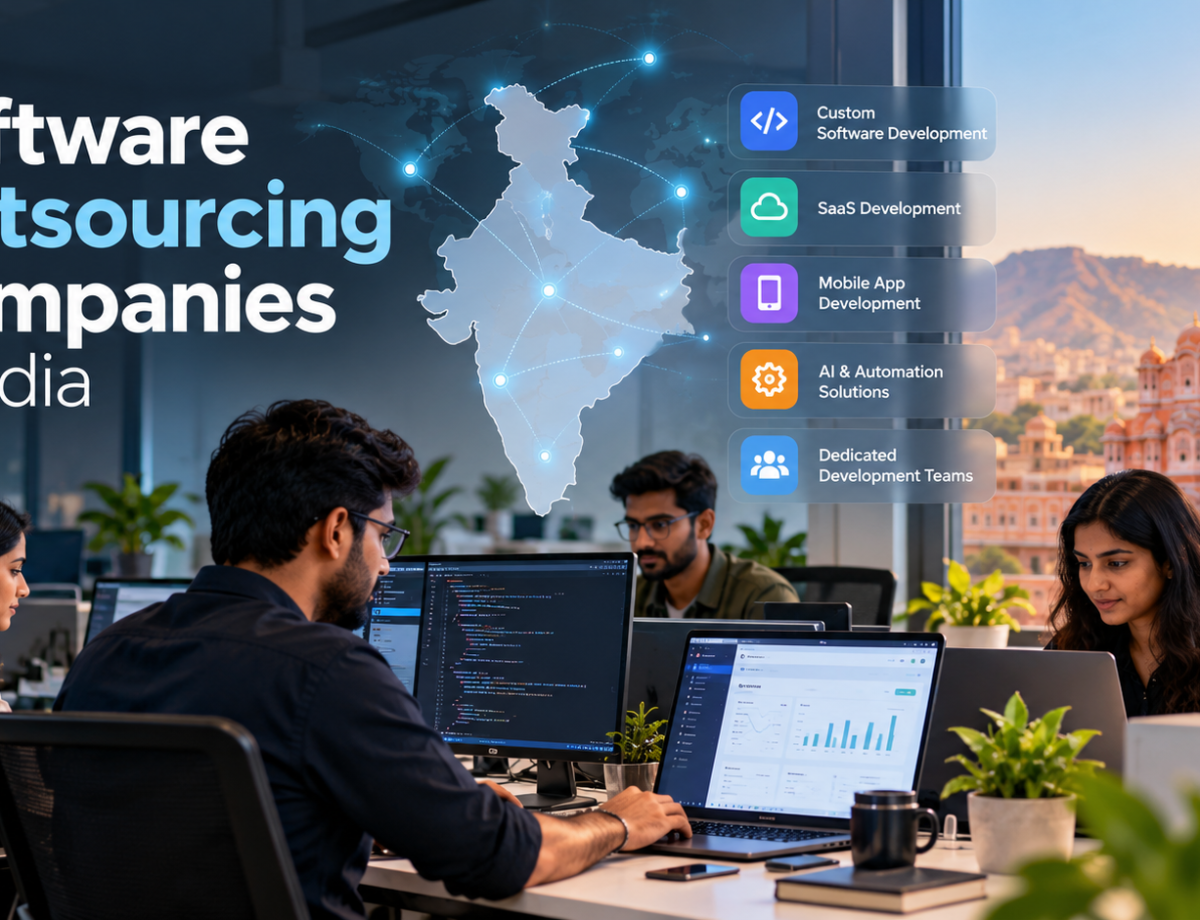
Software outsourcing companies in india offer a different kind of services. Depending on their technical skills and the focus of their business, These list of servicse can vary. Before selecting an out sourcing provider, its important to get to know about your product’s requirements. This way you can identifiy whether your needs matches with company’s expertises. Also according Secure Software Development Framework SSDF, there are some security, development processes, and vendor evaluation for secure software development practices.
Custom software development
Custom softwars are built to meet specific needs of a business,it includes processes, users, and its requirements.
For example – Custom software include internal business systems, industry-specific applications, operational dashboards, workflow management tools, and customer-facing portals.
Custom development could be the right choice if off-the-shelf software isn’t enough for your workflows or if you need more control over features and how the software integrates with other systems.
SaaS product development
Software as a Service (SaaS) provides subsription based services of its features. SaaS development often includes multi-tenant architectures, user manangement and authentications, subscription billing and invoicing, permission settings and RBAC (Role Based Access Control), usage limits, basic to advanced analytics, and integration with other platforms.
If you’re planning to build and launch a SaaS product, it is important to ask company about their experience with scalable architecture, tenant isolation, subscription management, security, and ongoing product development.
Web application development
Web apps helps businesses to deliver services, manage internal operations, and improving experience with customers through a web application.
Booking systems, customer portals, e-commerce platforms, reporting dashboards, and business management tools are some examples of web applications.
When selecting a outsourcing company in india, not only user interface but also ask about backend architecture scalability, performance, responsive design, accessibility, security, and integration requirements.
Android and iOS application development
Mobile applications plays important role to help businesses connect with their potential customers, support employees, or deliver services through smartphones and tablets. Development of customer-facing apps, booking applications, delivery platforms, healthcare apps, and internal worker tools can be the part of project.
Before finalizing the scope, have a conversation on key topics like device compatibility, app store deployment, authentication, API integration, analytics, testing, and future maintenance.
AI integration and business automation
A lot of the businesses are using artificial intelligence to enhance workflows and develop advanced product features. These kind of projects could include AI assistants, document processing, intelligent search, content generation, customer support automation, and integration with existing business systems.
An experienced tech partner should have knowledge about where AI can bring real value, how to protect data integrity, and how the results will be measured. AI should depicts a clear business value instead of adding into product just because it’s a popular technology.
Healthcare software development
Healthcare organizations may require a system to handle appointment scheduling, patient engagement, clinical administration, reporting, or operational management. These kind of systems require careful consideration of privacy of data, access control, security, compliance with healthcare regulations, and integration with existing systems.
If your project involves healthcare information, evaluate the provider’s relevant experience and their approach to compliance, testing, documentation, and data protection.
How to Choose the Right Software Outsourcing Company in India ?
Selecting an outsourcing partner is an one of the most important decisions of their business. A structured process of evaluation can led to avoid misunderstandings and ensure you find a company that can deliver your requirements.
Define your business requirements
Before approching to the development companies, ask yourself what you want to achieve ?
You don’t necessarily need a detailed technical specification. You can start by describing the business problem and expected solutions from software to solve it.
Your initial requirements should cover:
- The problem the software is meant to solve.
- Who the users will be.
- The essential features needed.
- Any required third-party integrations.
- Security and data requirements.
- Your estimated budget.
- Your target launch date.
- What kind of support you expect after launch.
- Separate the essential features from those that can be added later.
This helps potential providers give more accurate estimates and identify any questions that need clarification.
Evaluate relevant technical expertise
A company may offer a wide range of services, but that doesn’t mean all services are suitable for your project. Look for evidence that the company has experience with the technologies, integrations, and architecture your software requires.
For instance, a project involving a subscription-based web application might require frontend development, backend APIs, database design, payment integration, authentication, and cloud deployment.
Ask how the proposed team would approach these requirements and what technical trade-offs they expect. The goal is to find a team that can make informed technical decisions that benefit your business, not just developers who know a particular framework.
Review portfolio projects and case studies
A portfolio can give you an idea of what kind of work a company has done.
When looking at previous projects, look for similarities to your own requirements.
Relevant experience may include similar workflows, integrations, user volumes, security needs, or business models.
Useful questions include:
- What problem was the project intended to solve?
- Which components or modules did the company develop?
- What technical difficulties were encountered during development?
- How were testing and deployment processes managed?
- Is the project still receiving support or maintenance?
- Can the provider offer a reference or provide a more detailed case study?
- A set of appealing screenshots is not sufficient to determine the actual technical quality.
Whenever possible, assess working products, project outcomes, and the company’s specific role in the development process.
Evaluate communication and project management
Communication issues can slow down development, even if the technical team is skilled.
Before entering into an agreement, understand how the company manages requirements, approvals, progress updates, and changes in project scope. Clarify who your primary contact will be, how often you will receive updates, which tools will be used, and how urgent issues will be escalated.
You should also understand the development process.
Will the team regularly demonstrate working features?How will you provide feedback?Who approves completed milestones?
Having a clear communication process helps reduce uncertainty and allows both parties to make decisions before small issues become major problems.
Understand the development process
Ask the company to describe how it moves from initial requirements to the final deployment.
A typical process might involve discovery, requirement gathering, UX/UI design, development, testing, deployment, and post-launch support. The exact process can vary depending on the project, but the responsibilities and expected deliverables should be clearly defined.
For example, a milestone might include an approved design, a tested set of features, or a deployed release. Define how acceptance will be evaluated before work begins. Avoid agreements that promise a final delivery date without considering requirements, dependencies, testing, and client approvals.
Check security and intellectual property ownership
Security and ownership of intellectual property should be discussed before development starts, not after the product is completed. Your agreement should clarify who owns the source code, designs, documentation, and other deliverables.
It should also explain how the source code will be transferred or accessed and which third-party components are subject to separate licenses.
Depending on the project, consider:
- Confidentiality obligations.
- Access to repositories and code ownership.
- Role-based access controls.
- Secure handling of credentials.
- Data storage and transfer practices.
- Backup and recovery plans.
- Vulnerability management.
- Relevant legal and regulatory requirements.
If the software handles personal, financial, or healthcare data, obtain appropriate legal and security advice for your specific situation.
Do not assume that a general confidentiality clause is sufficient to cover all security and ownership concerns.
Compare complete proposals, not just prices
Request a written proposal that outlines the scope of work, deliverables, timeline, payment milestones, assumptions, exclusions, and support arrangements.
Two providers may quote very different prices because their proposals cover different aspects of the work. One may include design, testing, deployment, and documentation, while another may only cover development.
Compare proposals on a like-for-like basis. If something is unclear, ask the provider to explain it in writing. A transparent proposal makes it easier to estimate the total investment and helps reduce the likelihood of disputes later.
Evaluate post-launch support
Launching the software is not the end of the project.
Your application may require security updates, bug fixes, infrastructure monitoring, performance improvements, and new features. Ask what support is available after launch, whether a warranty period is included, and how ongoing maintenance is priced.
Also clarify response times, support hours, escalation procedures, and which issues are covered under the agreement. If the software is critical to daily operations, make sure you have a clear plan for handling incidents and maintaining access to the code and infrastructure.
How Much Does Software Outsourcing Cost in India?
The cost of outsourcing software development depends on the nature of the project and how the work is structured. A small business website, a custom operational application, and a subscription-based SaaS platform can have very different requirements.
The following factors typically influence a project’s cost.
Project scope and complexity. A project with a limited number of screens and simple workflows generally requires less effort than a platform with complex permissions, multiple user roles, reporting, payment processing, and external integrations.
Detailed requirements lead to more accurate estimates.
Design and user experience
Projects may require anything from a simple interface to extensive user research, prototyping, usability testing, and a custom design system.
If the application is customer-facing or involves complex workflows, investing in UX/UI design can help reduce usability problems and costly redesigns. Integrations with payment gateways, accounting platforms, CRMs, external APIs, and enterprise systems can add to development and testing effort.
Hosting, monitoring, backups, licenses, and third-party services may also create recurring expenses. These costs should be identified separately where possible.
Team composition and engagement model
The cost of a project depends partly on the skills and amount of work required.
A project may need developers, designers, testers, project managers, security specialists, or infrastructure engineers. A fixed-price engagement may suit a well-defined scope.
A time-and-materials arrangement may offer more flexibility when requirements are likely to evolve.
Neither model is universally better.
Choose one that fits the level of uncertainty and the way you intend to manage the project.
Maintenance and future development
Budget for more than the initial build.
Ongoing costs may include hosting, third-party services, monitoring, maintenance, security updates, and additional development. Ask the provider to distinguish one-time development charges from recurring operational expenses.
Practical tip: Rather than asking only for the cheapest quotation, ask each provider to estimate the initial build, list excluded costs, identify assumptions, and explain what ongoing support will require.
Common Mistakes to Avoid When Outsourcing Software Development
Even a promising outsourcing relationship can run into problems if important decisions are left unclear.
Choosing a provider based only on price
A low quote may omit essential features, testing, documentation, or post-launch support.
Compare the complete scope, delivery approach, technical capability, and total expected cost before making a decision.
Starting development without clear requirements
Unclear requirements can lead to repeated revisions, delays, and disagreements over what was promised.
Define the main objectives, essential features, acceptance criteria, and responsibilities before development begins.
Requirements can evolve, but changes should be documented and assessed for their impact on cost and delivery.
Ignoring communication and accountability
If nobody is clearly responsible for approvals, progress updates, or technical decisions, issues can remain unresolved for too long.
Agree on communication channels, reporting frequency, decision-makers, and escalation procedures at the start.
Overlooking code ownership and documentation
A business should understand how it will access its software, source code, deployment configuration, and technical documentation. Clarify ownership, repository permissions, handover requirements, and third-party licensing in the contract.
Failing to plan for maintenance
An application needs ongoing attention to remain secure, compatible, and useful as business requirements change. Decide in advance who will maintain the product, how support will work, and how future enhancements will be funded.
Is Software Development Outsourcing Right for Your Business?
Outsourcing may be a good option if your business needs technical expertise, wants to develop a digital product without building a full internal team, or requires additional engineering capacity for a defined project.
It can also work well for businesses that already have an internal technology team but need specialist skills or additional delivery capacity.
However, outsourcing is not the right solution for every situation. You should evaluate how much direct control you require, whether the necessary expertise is available internally, how sensitive the project is, and how you will manage the relationship.
A successful arrangement depends on clear requirements, realistic expectations, suitable technical capability, and effective collaboration. If you are unsure whether to outsource the entire project or only part of it, discuss the available options with prospective providers before committing to a particular model.
Frequently Asked Questions
What should I look for in software outsourcing companies in India?
When choosing a software outsourcing company in India, consider their technical skills, past projects, communication methods, development procedures, security protocols, contract terms, ownership of source code, and support after the project is launched.
When comparing options, focus on proposals that match your project needs instead of just choosing based on cost.
Is outsourcing software development to India suitable for startups?
Outsourcing can be a good option for startups looking to test an idea, build a minimum viable product (MVP), or gain access to technical skills without hiring full-time engineers right away.
Startups should clearly define the essential features, protect their intellectual property, set clear milestones, and maintain control over their product and code.
How much does it cost to outsource software development in India?
The cost depends on the size and complexity of the project, the level of expertise needed, any required integrations, and the type of engagement model used.
A basic app and a complex enterprise system can have very different costs.Always ask for a detailed estimate based on your specific needs rather than relying on a general price.
How long does outsourced software development take?
The timeline is influenced by the project’s scope, technical challenges, integration needs, testing requirements, and how quickly you provide feedback.
A project with a narrow focus may take less time than a complex SaaS or enterprise application.Ask providers to explain the schedule, including key milestones, dependencies, and assumptions.
Who owns the source code when software development is outsourced?
Ownership is determined by the contract, local laws, and the licenses for any third-party tools used.
Your agreement should clearly state who owns the source code, designs, documentation, intellectual property rights, access to the repository, and how the code will be handed over.It’s advisable to seek legal advice if needed.
Can I outsource only part of a software development project?
Yes, Companies can outsource specific tasks like UI/UX design, backend development, mobile application creation, testing, cloud deployment, or ongoing maintenance.This is helpful when an internal team handles other parts of the project.
What is the difference between software outsourcing and staff augmentation?
Software outsourcing usually involves hiring an external company to complete a defined set of development tasks or manage a team. Staff augmentation involves adding skilled professionals to an existing team, with the client having more direct oversight of their work.The exact setup depends on the terms of the agreement.